
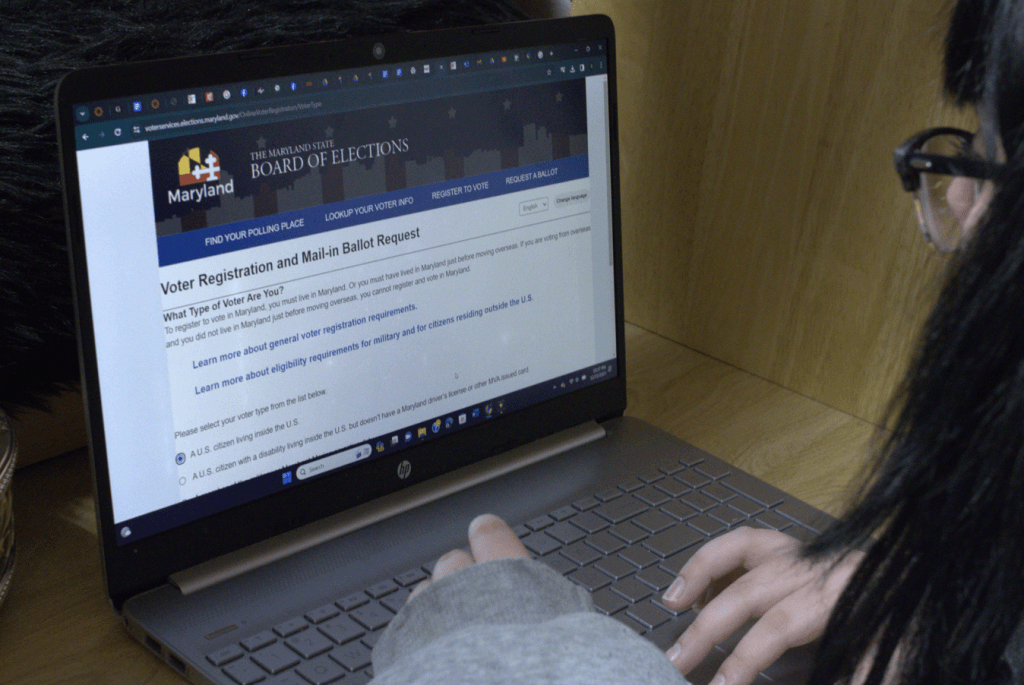
SU freshman Maddie Wade registering to vote in preparation for the next presidential election.
To the dismay of many young Americans, the upcoming 2024 presidential election is likely to be a rematch between Joe Biden and Donald Trump, replete with the bickering, jabs and gaffes that characterized the 2020 debates. College students preparing to vote for the first time in their lives are largely unenthusiastic about either of the front-running candidates, fostering political apathy throughout the country.
Extreme polarization in America is all too common, facilitating the division that makes citizens wary of becoming civically engaged. When it comes to third-party candidates who fall outside of the mainstream political arena, voters tend to correctly view them as improbable winners.
Salisbury University is an Eastern Shore institution home to a large population of young adults, many of whom will be exercising their right to vote in the next presidential election. Among students who keep up with politics as well as those who aren’t as interested, no one is able to avoid exposure to the American political climate.
Connor Kinch, an SU sophomore majoring in Bio-Environmental Science, laments how the American political system functions to exclude outsiders from a chance of electoral success.
“I particularly think that it is screwy, to say the least, that we only vote for the biggest names out there and all the smaller names that might have more beneficial views [or] more appreciated views for the entirety of the country are not really seen,” Kinch said. “I think it’s dumb that [independent candidates] are not seen, and they should be.”
Although Kinch does not favor either of the two leading partisan candidates and would prefer voting for an electable third-party runner, he finds it improbable that an outsider could actually win.
“I think it’s very unlikely that any of those [independent] candidates will gain enough supporters who will [vote] for them to actually win,” he said. “So, thinking about that, I’m either going to vote for an independent or a lesser of the two evils…”
Sydney Abrams, an SU freshman majoring in Health Sciences, does not usually keep up with politics due to the stress it causes combined with a lack of interest in political matters.
“[I have] a much more negative outlook on everything than positive,” she said. “[Trump and Biden] both do a lot of stupid things.”
Abrams’ prediction of which candidates have a likelihood of winning the presidential election is similarly pessimistic.
“It’s [probably] going to be between Biden and Trump, because half of the world is in love with Trump and the other half hates him.”
However, there have arisen alternative options to both Trump and Biden on the national stage. Independent candidate Robert F. Kennedy, Jr has been gaining considerable traction since his departure from the Democratic party in early October, especially among young adults throughout the country.

One of many college petition-signing events held by volunteers of the Maryland Kennedy campaign. Josh Mazer is standing to the far left.
Josh Mazer, the Maryland Director of the Kennedy campaign, has been traveling to universities across the state as part of an ongoing college petition-signing tour, one of which happened to be Salisbury University.
“I think it’s always good to see people making positive choices for their future; as far as this campaign goes, if you’d like to give yourself another choice… signing the ballot petition is not a vote, it just means that when you walk into the voting booth, you’ll have a third choice beyond Biden and Trump,” Mazer said in an interview. “That’s what this is all about.”
Mazer has been working to garner signatures from 10,000 registered Maryland voters, the required sum needed to get an independent candidate on the ballot. Unlike other third-party presidential initiatives, members of the Kennedy campaign have interacted with the SU community at a grassroots level.
In the face of the looming presidential election, young Americans worry that the contest will be constricted to only two polarizing candidates, per usual. It is, however, important to understand that there are viable alternatives to pick from.
By COLIN McEVERS, Writer

 Maryland Maverick News
Leave a comment