
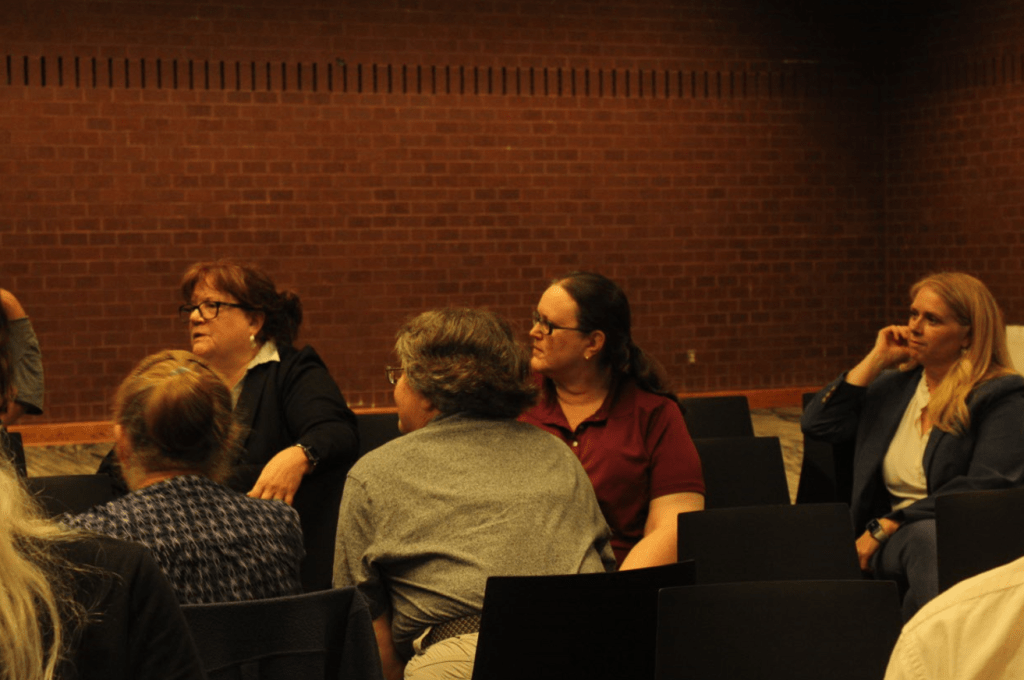
Last night, on Sep. 18th, Salisbury University hosted a Free Speech Forum to commemorate Constitution Day, a day the university is legally obligated to recognize. The event, moderated by Dr. Sandy Pope, director of the Public Affairs and Civic Engagement (PACE) program at SU, promised to foster dialogue about the role of free speech on campus. However, as the discussion unfolded, many attendees were left questioning the depth of the university’s commitment to the very principle it claimed to celebrate.

The highlight of the evening was the participation of SU President Dr. Carolyn Ringer Lepre, who opened the forum by reaffirming her support for robust, open dialogue.
“There must be a robust dialogue, otherwise we are not free,” she remarked. Lepre’s words echoed the ideals of the First Amendment, emphasizing that college campuses should be a place for all conversations to happen, no matter how uncomfortable or unpopular they may be.
However, when the forum opened for a brief question-and-answer session, it became clear that not everyone on campus feels that free speech is truly welcome—particularly conservative voices. Multiple students and staff expressed frustration that conservative viewpoints are often censored or marginalized.
One student recounted their experience trying to publish an article in The Flyer, SU’s student newspaper, in response to a series of highly polarized articles previously published in April, 2023. The submission was denied and when the student posted printed articles on public bulletin boards throughout campus, they quickly disappeared, which the university seem to have been responsible for.
The student asked President Lepre directly why their article was taken down and what protections exist to ensure that conservative viewpoints are not censored.
“I’m not sure I have the facts to answer the question as effectively as it needs to be answered,” Lepre said. This answer seemed particularly unsatisfactory, considering that the student handed Lepre a printed copy of the article in April, 2023, during the height of the controversy.
The event had a notably low turnout, with much of the audience reportedly comprised of attendees paid by Lepre’s administration to be present. Organizers of the event later revealed that the university had apparently restricted their ability to properly advertise, likely contributing to the sparse audience.
The gap between the administration’s rhetoric and its actions became even more apparent as the forum progressed. Despite the positive language from Lepre and other officials about free speech, when asked direct and difficult questions about censorship and free speech protections on campus, they had little to offer in terms of clear, concrete answers.
When questioned about how the university draws the line between free speech and hate speech or harassment, Lepre candidly admitted, “I don’t have a good answer.”
For a panel led by the president of the university and attended by her top staff, this lack of clarity left some in attendance unsatisfied and concerned.
One of the most concerning moments came toward the end of the forum when the idea of “free speech zones” was raised as a potential initiative for SU. Lepre and her staff appeared pleased with the idea of establishing designated areas where students could post articles and share their thoughts.
However, it could be argued that the notion of a “free speech zone” signals a fundamental misunderstanding of the First Amendment. The entirety of the United States is a free speech zone, as guaranteed by our Constitution. To suggest that certain areas of campus should be designated for free speech implies that those rights might not apply outside these zones—a concept wholly incompatible with the law of the land.
Will there soon be other zones where constitutional rights only apply? Such a step would mark a dangerous precedent for limiting rights that should be protected in all spaces.
While President Lepre’s comments regarding the importance of dialogue were encouraging, her administration’s actions—or inaction—speak louder. Free speech on campus should not require special zones or conditional protection. It must be defended across the entire university, for all voices, without selective enforcement based on ideological lines.
As Salisbury University continues to navigate the complexities of free expression, it is imperative that the administration not only talks about free speech but actively protects it. Real free speech cannot exist where certain viewpoints are censored or where protections are vague and unenforced. The Constitution guarantees these rights for all, and it is up to institutions like SU to uphold them—without compromise.
By Luke Hartlaub
The-Examiner Editor
Featured image courtesy of The Bury Post
 Maryland Maverick News
Leave a comment