
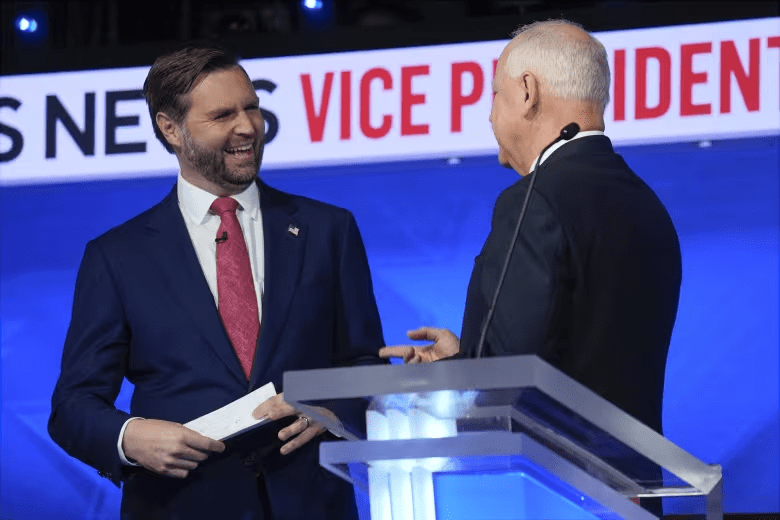
Professionalism, civility and coherence have certainly been uncharacteristic of America’s political climate over the past decade, particularly in the case of presidential debates. However, on Oct. 1, the Vice Presidential debate between J.D. Vance and Tim Walz proved an exception to the trend. The two candidates gave viewers the gift of respectful and policy-oriented discourse.
Although the Salisbury University community tends to be politically apathetic – following nationwide trends of political disengagement – Political Science professors and a small number of students had insight to provide.
Of thirty random students questioned, only five took the time to watch the Vice Presidential debate on Tuesday. ⅘ described themselves as more left-leaning and ⅕ described themselves as more right-leaning, whereas ⅗ believed Walz won and ⅖ thought Vance won. National polling shows that the performances of both candidates are tied in regards to popular opinion, with partisan affiliation shaping perceptions of who did better.
John Lanasa, a SU freshman majoring in Political Science who describes himself as more left-leaning, thinks Walz won the debate due to the difference in policy arguments.
“Even though he seemed more nervous at times and I guess JD Vance seemed very sure of himself, JD Vance was still arguing [for] a lot of Trump’s policies and a lot of them didn’t correspond with what he’d said in the past, and that definitely hurt him,” he said.
Although he isn’t the largest fan of Vance, Lanasa was not expecting the debate to be as professional as it ultimately proved to be. In fact, he came away from the performance with more respect for the Republican VP candidate.
“I think it was massively more productive, I mean, I think both candidates definitely stated their cases,” he said. “It’s like one of the first times I’ve really heard Trump’s policy and things that he cares about, like presented so well, so I think that was hugely more productive than the Trump-Kamala debate.
“A lot less insults.”

Michelle Fletcher, who has a doctorate in Political Science, has been teaching courses at SU for over three years. She believes the debate was a tie, as each candidate utilized novel styles to achieve the goals they wanted to fulfill.
“JD Vance was not in a good place [favorability ratings], so he had to come in and make people like him a little bit better,” Fletcher said. “Tim Walz, he was in a better place, but he needed to a little bit of work in terms of introducing the American people to Kamala Harris’ policies.
“So they both had jobs to do and I think they both did that effectively.”
National favorability ratings for both Vance and Walz increased substantially in the aftermath of the VP debate.
Leonard Robinson, who has a doctorate in Political Studies, is the Director of International Studies and has been teaching at Salisbury University since 1998. He thinks that, stylistically speaking, Vance won the debate, although he suspects that this will not make much if any difference in the election outcome.
“I don’t really think either side gained that much because history tells us VP debates really don’t move the needle that much, so I think that’s the case,” he said. “Now, I think to the extent that the perspective was after last debate that Trump was teetering a little bit, weakened a little bit by that debate performance, this probably helped him a little bit, but I just don’t know that it’s gonna move the needle that much.”
With Vance’s youth and political aptitude, there is a widespread prediction that he may be the future leader of the Republican Party once the era of Trump concludes. Last Tuesday’s debate has enhanced the speculation of a Vance 2028 presidential run.
“I can imagine that he has the potential to be the future leader of the party, and I think that might have something to do with why he answered the question on abortion the way he did,” Robinson said. “He was kind of trying to move himself away from Trump a little but, but not completely, because understandably he feels like he can’t do that because of political reasons.
“But yeah, I get the feeling that he’s trying to maneuver himself into that [position]; I think that was really one of the things that they had in mind when they selected him, right, Trump’s sons said, ‘hey, he’s the guy that could be the next leader of the Trump movement.’”
By COLIN McEVERS
Editor in Chief
Featured image courtesy of AP News.

 Maryland Maverick News
Leave a comment