
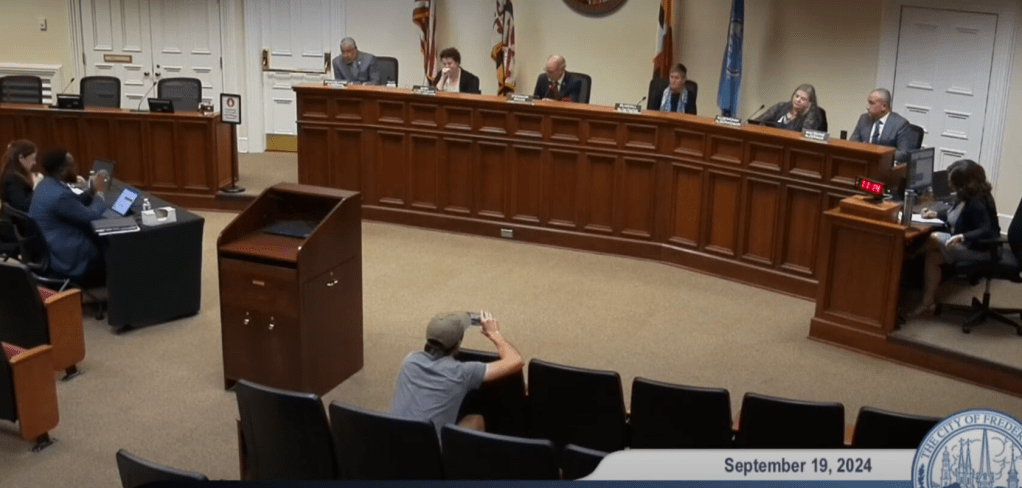
In a move that has left many residents of Frederick, Maryland, outraged, the city’s Board of Aldermen voted in late September to allow non-citizens—including Green Card holders and undocumented immigrants—to vote in local elections.
This decision, passed in a 4-1 vote, bypassed public input, leaving citizens questioning the value of their own citizenship and the democratic process. This controversial change has serious implications, not just for Frederick, but for other cities in Maryland, including Salisbury, where similar debates may arise.
Devaluing Citizenship
At the heart of the uproar is the perceived attack on the very essence of what it means to be a U.S. citizen. Voting has long been considered one of the most fundamental rights that comes with citizenship, a reward for the long and often arduous process of becoming a naturalized citizen. Yet, Frederick’s decision to extend voting rights to non-citizens undermines this distinction.
As Alderman Kelly Russell, the lone dissenting vote, pointed out, many who worked diligently to earn their citizenship feel that this decision diminishes their efforts.
“I have spoken to many people who worked hard to earn their citizenship and the right to vote, and they are deeply opposed to this,” Russell said.
For those individuals, the ability to vote represents years of commitment to the nation, an effort that is being diluted by allowing non-citizens—who haven’t gone through the naturalization process—to participate in elections.
This is not merely about inclusivity or expanding democracy; it strikes at the very heart of what it means to belong to the civic body of a country. Citizenship is supposed to carry certain rights and privileges, and voting is one of its most sacred. If non-citizens are granted the same voting rights as citizens without the same responsibilities, what value does citizenship truly hold?
Bypassing the People: A Dangerous Precedent
One of the most troubling aspects of Frederick’s decision is the way it was enacted. The Board of Aldermen passed this law without giving residents the chance to weigh in through a public referendum. For many, this feels like a slap in the face to the democratic process itself. When such a significant change is made without consulting the public, it leaves citizens wondering who their local government truly represents.
This unilateral decision sets a dangerous precedent. If local governments can extend voting rights to non-citizens without public approval, what’s to stop them from making other significant changes to voting laws? By bypassing a referendum, the Board of Aldermen undermined the very principles of democratic governance, making many question whether their voices even matter.
What This Could Mean for Salisbury
As Frederick becomes the largest city in Maryland to allow non-citizens to vote, other cities may soon face pressure to follow suit. Salisbury, with its own growing immigrant population, could very well find itself at the center of a similar debate in the near future. While Frederick’s decision has sparked outrage, it also sets a precedent that other cities, including Salisbury, may feel inclined to explore.
But before Salisbury heads down this path, it must carefully consider the consequences. Will allowing non-citizens to vote in local elections further erode the value of U.S. citizenship? And more importantly, will Salisbury’s residents be given a say, or will they too be sidelined by local officials eager to push through changes without public consent?
The value of citizenship is not something that should be easily diminished, especially when so many have worked so hard to obtain it. Salisbury must decide whether it will protect the sanctity of citizenship or risk following in Frederick’s footsteps, where the value of belonging to the civic body seems increasingly up for grabs.
Conclusion: A Decision That Undermines Democracy
Frederick’s decision to allow non-citizens to vote in local elections is not just about expanding voter eligibility—it is about fundamentally altering what it means to be a citizen.
By granting non-citizens voting rights without requiring the same level of commitment to the country, Frederick has devalued the very concept of citizenship. And by making this decision without public input, the city has set a dangerous precedent that could ripple through other communities, including Salisbury.
As Salisbury watches this unfold, it must consider the broader implications. Citizenship is more than just residency; it is a bond that carries both rights and responsibilities. If that bond is weakened, we risk undermining the very principles that hold our democracy together.
By Luke Hartlaub
Examiner-Section Editor
Image courtesy of WUSA9



 Maryland Maverick News
Leave a comment