
Cancel culture, censorship and feelings of uncomfortability with expressing unpopular opinions: in the past few years, these factors have sparked a resurgence in focus on freedom of speech, which has become a prime concern in popular culture and the academic world. Salisbury University is not immune to this trend, as several members of the community have expressed fear over the protection of free speech on campus, worries which resulted in both a Free Speech Panel as well as discussions in the faculty senate in the Fall, 2024 semester.
According to Best Colleges, although more than ⅔ believe that all people should be able to express personal beliefs, only 44% of college students nationwide feel comfortable freely speaking their minds. Of these students, 54% of Democrat students and, on the other hand, 39% of Republican students feel comfortable with expressing opinions.
More than half of college students nationwide report they have experienced limitations to voicing their views on campus or are neutral on the subject; only 44% boldly say they have not experienced limitations.
Mary DiBartolo, a nursing professor who has been teaching at SU for several decades, has been a leading free speech defender on campus for years. She is also a member of the faculty senate and brought up the topic of freedom of speech at a session to President Carolyn Lepre.
“There’s been ridicule by some faculty in classrooms, some of which in the political science department, which to me should be a place where there should be, there’s supposed to be, discussion about political views,” she said. “I just find it very discouraging, but at the same time it seems like an opportunity for us to look at some more concrete ways to keep this [free speech] initiative going to really make sure all students, faculty and staff can freely speak their minds, in a civil way.”
According to DiBartolo, who is also an advisor for the College Republicans, various students and faculty have approached her to either communicate fears about expressing their conservative opinions, to address potential violations of free speech on campus and to voice concerns about the actions of certain professors.
Jacob Hornsby, a SU junior majoring in political science, is one of these students who has privately brought forth concerns regarding the topic of free speech on campus.
Also covered on YouTube, The Bury Post Media.
“In a class, I had a bad experience where we were talking about [political topics], me and the teacher got into an argument; that’s kind of made me stay off a bit from talking about my politics,” he said. “When I’m trying to remember, I think I shut down, because I didn’t expect that…”
Open dialogue and disagreements are arguably resourceful in a classroom setting, particularly when it comes to posing challenges to ideas in a political science course, a fact which Hornsby acknowledges. However, when other students expressed more left-leaning stances in the lecture, he noticed a difference in the professor’s demeanor.
“[They] basically agreed with them, it seemed to me [they] were favoring one side over the other,” he said.

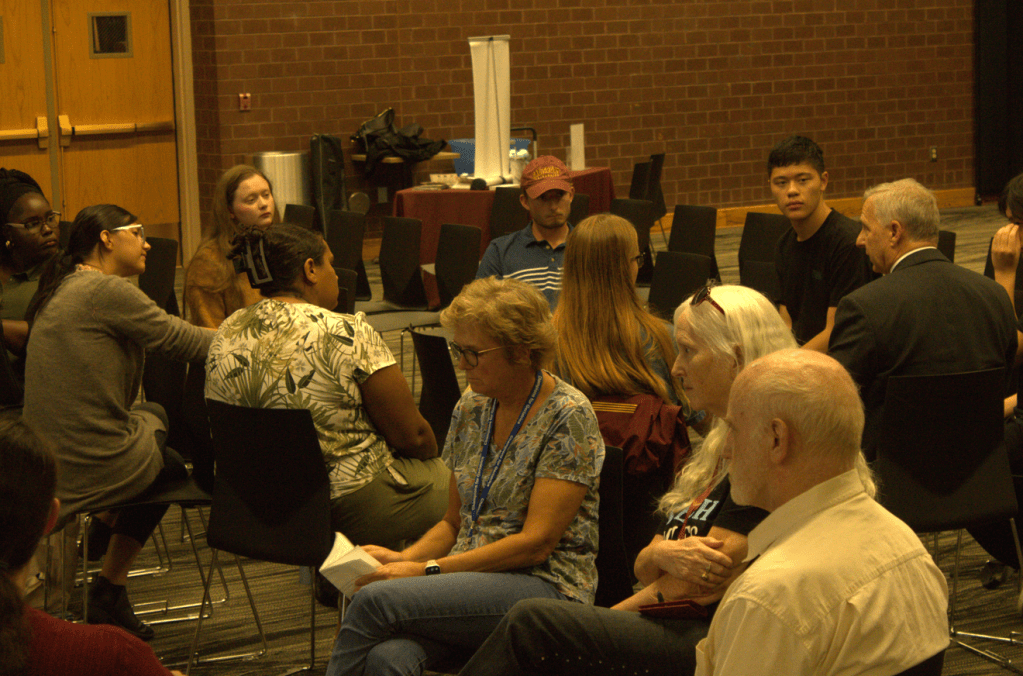
On Sep. 17, a date marking “Constitution Day,” SU’s Public Affairs and Community Engagement (PACE) hosted a Free Speech panel led by faculty members of the school, including professors and President Carolyn Lepre. Historically, faculty have used the occasion to set up a table in the Red Square to disseminate copies of the U.S. Constitution.
This year, with rising tensions over the subject of free speech, PACE decided to implement a panel format, intended to reiterate the university’s commitment to protecting the first amendment.
During the panel, the moderator posed a question regarding the extent of free speech, whether certain statements are considered to be harmful, and whether there are trains of thought we should shut down.
Michelle Fletcher, who has a doctorate in Political Science, was one of a group of panelists at the event. Her understanding of free speech rests in the fact that social progress movements would not be possible without the right of individuals to express their minds.
Fletcher was the first to provide an answer to the question.
“That’s a very challenging question to answer: violence, things that incite violence, we understand that thinking about speech as a legal question, not all speech is protected speech, so we have to start there,” she said.
Fletcher made reference to the Israel-Palestine protests that largely escalated throughout college campuses in the earlier half of this year and the legal backlash received by the presidents of these institutions, focusing on the contrast between existing DEI policies and the absence of policies addressing anti-semitism on these campuses.
“This is what got a lot of administrators dragged into congress recently, for trying to, I don’t want to say defend, but explain specific policies on their campus that were designed for Diversity, Equity and Inclusion to cover certain issues and protect certain groups that were experiencing certain types of issues on campus or throughout society…,” she said.
“When the Israel-Gaza thing started happening and we saw what happened during that incident, everyone’s like, ‘well, why isn’t there a specific policy to address anti-semetic hate on college campuses?’ Well, for the past X amount of years, that’s not something that was a major problem on college campuses, and so people got dragged into congress and accused of ignoring a problem, when in actuality it was just an issue of giving [the institutions] time to respond to a problem that is currently arising.”
In regards to concerns over student voices being silenced in class, Fletcher says that she does not shut students down, but rather tries opening the discussion to steer students towards the correct answer about a topic.
“Oftentimes, you’re going to get some pushback on some things, but that’s part of that process of engaging in an academic community, that exchange of ideas, that dialogue, but that doesn’t mean that you’re being targeted, that’s just part of the process” she said.
Nearing the conclusion of the panel discussion, the floor was opened for audience questions.
Luke Hartlaub, a SU graduate student, expressed concern that his news articles, which were written in response to highly opinionated pieces in Spring, 2023, were censored by the school’s former print student newspaper, The Flyer, and swiftly removed from public bulletin boards when he printed out his piece.
“There is a feeling on the SU campus by many professors, students and faculty, and I feel like that was a real manifestation of that feeling, being denied positions and publication,” he said. “As the student newspaper for SU and student media in general, what protections are there in place to make sure things like this don’t happen?”
Members of the administration in attendance responded that student media sources have full autonomy over what they publish and do not publish because they are paid through the student activities fee and that the articles posted on the public boards had likely been removed because they did not go through proper administrative channels.
In the weeks following the Free Speech Panel and Faculty Senate discussions, DiBartolo reached out to other sources in an attempt to adequately address her concerns and the ongoing problems facing the SU community.A meeting was set up between DiBartolo and the Vice President of Inclusion, Access and Belonging at SU, Zebadiah Hall.
DiBartolo stressed the feeling that conservative voices are being silenced on campus, argued that DEI trainings assigned to her department & others are counterproductive in the sense that they compel speech and recommended some sort of vetting process for these training modules.
Hall was not familiar with the content of the trainings, though he intends to look through the modules and see what exactly they entail. There are certain faculty members throughout the school who select and administer different trainings to professors; Hall said that he will try locating the centralized selectors of these training modules.
Both DiBartolo and Hall agreed that further training on freedom of expression and the first amendment was necessary, an issue which Hall admits has come to the surface on several occasions, from both ends of the political spectrum. In the potential development of new trainings on free speech, DiBartolo and other concerned members of the SU community will be used as “sounding-boards,” according to Hall.
By COLIN McEVERS
Editor in Chief
Featured image courtesy of Colin McEvers
 Maryland Maverick News
Leave a comment