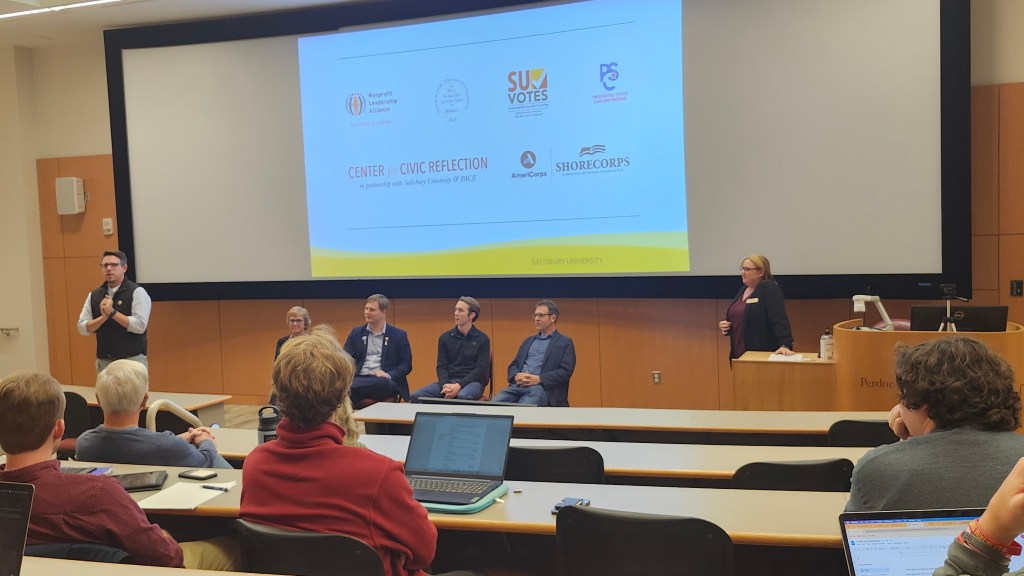
As part of Salisbury University’s Public Affairs and Civic Engagement (PACE) Democracy Across the Disciplines series, a panel of political and academic voices gathered on Nov. 4 at 7:00 P.M. to explore “Partisan Predictions for the 2024 General Election.” This free event, open to the public, aimed to dissect what drives voter turnout at local and national levels and discuss ways people can stay engaged beyond Election Day.
Jennifer Cox, who has a doctorate and is a professor in the Department of Communication, moderated the conversation, bringing together perspectives from both liberal and conservative panelists on pressing local, state and national issues.

Meet the Panelists
The diverse lineup included Joe Venosa, a History professor at SU and chair of the local “Yes to Question A” Committee, who emphasized coalition-building around specific issues in Wicomico County; Jared Schablein, an SU Political Science graduate and chair of Shore Progress, represented Eastern Shore progressive interests with experience in local campaigns; Mary DiBartolo, a nursing professor who has taught courses at SU for three decades, voiced concerns about freedom of speech on college campuses, particularly for conservative perspectives. Rounding out the panel was Patrick Kerr, an SU graduate and current president of the Wicomico County Republican Club, with a focus on local government and conservative issues.
Key Issues Driving Voter Turnout
When asked about the issues driving voter turnout locally and nationally, Venosa highlighted the significant role of Question A in Wicomico County. As chairman of the “Yes to Question A” Committee, Venosa emphasized the need for a broad coalition to support the initiative, which has sparked extensive debate.
Dr. Joe Venosa noted that Question A offers an opportunity to focus on local governance and community improvement. Venosa also acknowledged a general climate of fear, particularly surrounding reproductive rights and political violence, which has led to heightened concerns across the political spectrum.
Patrick Kerr echoed Venosa’s emphasis on local issues, especially Question A and education, describing these as major drivers in Wicomico County. He also acknowledged the fear many voters have.
“Whether you are Republican, Democrat, Independent, Libertarian, Green Party, or from any other party, I think we can all agree: one thing this nation cannot survive, and a healthy democracy cannot survive, is the idea that every election should be driven by fear,” he said, underscoring the importance of moving beyond fear-based motivations in politics.
Jared Schablein pointed to issues like abortion access and healthcare after extensive door-knocking in the area, stressing that local residents want affordable housing, quality healthcare and the freedom to make their own medical decisions without political interference.
“We are seeing a lot of people leave the area”, he said, while emphasizing that local action can help people start businesses and invest in the community.
Dr. Mary DiBartolo offered a different perspective, identifying inflation and immigration as key concerns. She argued that current immigration policies prioritize immigrants over American citizens, veterans and the homeless, voicing frustration with the perceived economic strain that recent immigration policies place on resources.
Personality vs. Policy: What Drives Voters?
Schablein emphasized that, although personality plays a significant role—especially at the national level—he believes the average voter is more insightful than often assumed.
“I would not degrade the average voter and think they are not smart enough to recognize what issues affect them,” he said, adding that people care deeply about their families, opportunities for their children and improving their communities.
Kerr added nuance, noting that personality can matter in any race, but particularly in small-town politics like in Wicomico County.
“I think you have a little bit of both,” he said, suggesting that voters’ focus on personalities versus policy often depends on the election level.
Kerr explained that local elections frequently attract voters who are personally acquainted with the candidates or see the direct impact of local policies, making both personality and policy essential factors.
Venosa provided a historical perspective, pointing out that personalities have always influenced politics, not just in 2024.
“You don’t get the New Deal without FDR and you don’t get Trumpism without him,” he said. Venosa believes that while everyone cares about specific issues, it’s often the personalities behind these issues that drive engagement.
DiBartolo focused on the practical side, stating her preference for leaders who can “do the job to make this country a better place.”
She voiced concerns about the suppression of speech and the direction the country might take, adding, “Fear has been mentioned, and I fear what happens in this country if we go a certain direction.”
DiBartolo underscored that while personality can capture attention, her primary interest is in a leader’s ability to enact effective policies.
Social Media and the Spread of Misinformation
The panel was also asked about the reliability of social media as a source for political information and the risks of misinformation. Venosa voiced concerns about social media’s impact on civil discourse, citing death threats he received over his involvement with Question A.
“You don’t have freedom without responsibility,” he stressed, calling for accountability in online interactions.
Schablein discussed his own experiences with antisemitism online and criticized partisan reluctance to address dishonesty within their ranks. He described social media as a “bubble” detached from real-life issues.
Kerr urged the audience to focus on in-person conversations rather than social media interactions. “At the end of the day, we all live in the same community,” he said, highlighting the importance of constructive dialogue and responsibility in exercising free speech.
DiBartolo shared her dismay with mainstream media’s one-sided coverage, arguing that many outlets “manipulate the truth.”
Early Voting Trends: Shifting Habits and Participation Concerns
With early voting already underway, more than 78 million ballots have been cast, according to CNN—down from the 110 million in 2020. The panelists discussed whether this shift reflects a return to traditional Election Day voting or if it signals a potential decline in overall turnout.
Schablein noted that some voters simply prefer the tradition of voting on Election Day, while others need consistent reminders to get to the polls.
“It doesn’t matter how you vote, just vote,” he said, encouraging early voting for those wanting to avoid last-minute reminders. Schablein highlighted the importance of turnout in close races, noting that Wicomico County was decided by less than 2% in the last presidential election.
Kerr reflected on the unique circumstances of 2020, when people were home due to COVID-19 and many states mailed ballots directly to voters, bolstering early voting numbers.
“More Republicans voted early than ever before,” he said, but also raised questions about whether the trend would continue, especially if the GOP relies heavily on traditional Election Day turnout. He speculated about the potential for another “red mirage” if early results appear Republican yet shift with final counts.
DiBartolo pointed out that many Republicans typically vote on Election Day, mentioning that when she went to the early voting site at the Wicomico County Civic Center, it was “mobbed”—a turnout she found encouraging.
Venosa added that early voting is reshaping how people approach the election. He pointed out local confusion, noting that in Wicomico County, early voting is available at two specific locations—the First Baptist Church and the Civic Center—which may lead to logistical misunderstandings. Venosa believes this changing dynamic affects voter habits and that it’s crucial to adapt communication to help voters understand their options, ensuring all voices are heard.
Voter Concerns and Panelist Advice
The panelists discussed a range of concerns they’ve heard from voters, touching on security, trust in the election process and navigating the voting options available. Each shared insights on what they’ve encountered while engaging with the community and how they’re addressing these worries.
Schablein emphasized his confidence in the court system, particularly regarding ballot issues. He expressed faith that the Supreme Court would not interfere with the outcome of an election.
Schablein also reassured voters of the safety of polling places, mentioning the presence of local police to maintain a secure environment. To assist anyone facing issues, he reminded attendees that many organizations and political parties provide hotlines to report concerns on Election Day.
DiBartolo voiced her support for potentially making Election Day a national holiday to encourage higher turnout. She suggested returning to a single voting day as a way to restore public trust in the process, noting that COVID-19 introduced new voting methods that some believe raised security concerns. DiBartolo’s stance reflects her desire for a straightforward and secure election process.
Kerr encouraged voters to choose whichever voting method they trust most, whether it’s early voting, mail-in or in-person Election Day voting. Reflecting on past experiences, he shared a story from two years ago when a polling place issue was quickly resolved, showing that local officials take election security seriously and are prepared to handle challenges effectively.
Venosa acknowledged that while local voters often feel secure in the process, many still have broader concerns about election integrity on a national scale. He emphasized that these anxieties often stem from abstract fears rather than direct local issues. His advice was to focus on the security of local processes, as these are generally trusted and carefully monitored, and he encouraged people to vote with confidence in their local election officials.
Maryland Voters and the Value of Their Vote
The panel also tackled a concern unique to voters in reliably blue Maryland: the sense that their vote may feel less impactful in national elections, especially as presidential candidates focus their campaigns on swing states like Arizona, Georgia and Pennsylvania. This sense of detachment from the national political landscape has left some Marylanders wondering if their participation truly matters. The panelists agreed, however, that Maryland voters still play a crucial role, particularly on local ballot issues and races that directly affect their communities.
Venosa argued that local issues like Question A—on which he’s actively campaigning—have tangible effects on residents’ day-to-day lives. He stressed that even in a non-swing state, voters have the opportunity to make a difference on local initiatives and should see these as essential areas for civic engagement.
Venosa underscored the importance of Maryland’s ballot questions, explaining that these issues can bring immediate change and address specific needs within the community.
Schablein echoed this sentiment, pointing to Florida, where ballot measures on issues like minimum wage and marijuana legalization successfully passed even in a state with a strong partisan leaning.
He suggested that Marylanders can look to similar efforts, where community-driven issues motivate people to vote regardless of the national outlook. Schablein also mentioned Senate candidate Angela Alsobrooks, whose campaign could bring new representation to the Maryland Senate, inspiring voters who want to see a broader range of voices in office.
Kerr highlighted that Maryland’s Senate race, with former Governor Larry Hogan polling within 10 points, shows that any race has the potential to be close. He pointed out that there is little polling on local issues like Question A, making it all the more important for Marylanders to turn out, as the results could go either way. He argued that participation in local elections, where individual votes have a much larger impact, is crucial.
DiBartolo added her perspective on the need for clarity and transparency around ballot questions. She noted that certain ballot questions, like Maryland’s Question 1, are often presented in a way that may not fully explain their implications.
DiBartolo expressed concern that voters could make decisions based on incomplete information, and she advocated for making ballot language more accessible. This led to a broader discussion among the panelists on how to improve voter education, particularly around issues that impact Maryland voters directly.
The panel concluded that while Maryland may not be a swing state in presidential elections, the importance of local and state issues on the ballot cannot be overstated. By focusing on these issues, Maryland voters can make a significant impact in their communities and shape the future of the state in meaningful ways.
Staying Engaged After Election Day
As the conversation turned to life after Election Day, the panelists offered insights on how to stay engaged with democracy year-round. For Schablein, civic engagement doesn’t end with casting a vote. As chair of Shore Progress, a local non-partisan organization, he emphasized the importance of continuing involvement in issues that matter.
“Voting is only one step,” Schablein said. “Afterwards, find what you care about and get involved.” He encouraged Marylanders to support initiatives that benefit working-class communities and to hold elected officials accountable between election cycles.
Kerr shared specific ways for students and young adults to stay connected with local politics. Kerr highlighted SU’s internship opportunities in Annapolis, where students can work directly with state legislators.
“Going to your local meetings… and even considering a run for office” are great ways to make your voice heard beyond voting. He also recommended grassroots activities like door-knocking and phone banking to amplify one’s influence.
Venosa pointed to the importance of local issues, particularly in smaller communities. He reminded the audience that, at the local level, even a single vote can make a substantial difference.
“In a county or town, your vote matters,” he said. “Literally one or two votes can shift the outcome.”
Venosa encouraged voters to take ownership of local concerns, where the impact of their involvement is often most visible and meaningful.
Conclusion
Salisbury University’s Partisan Predictions panel provided a forum for thoughtful discourse on the issues shaping the 2024 election. While panelists shared diverse viewpoints, they all underscored the importance of informed and responsible engagement.
By LUKE HARTLAUB
Examiner Editor
Featured image courtesy of Colin McEvers
 Maryland Maverick News
Leave a comment