
Phillip Nguyen
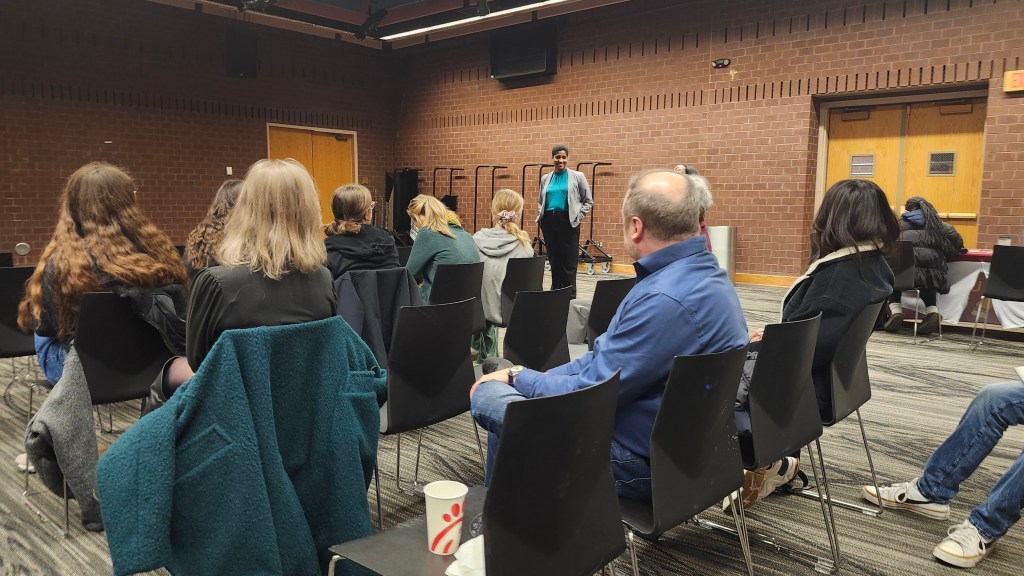
On Feb. 6, a Black History Month keynote lecture regarding the history of “Black vaudeville” was delivered by Michelle R. Scott, who has a doctorate and currently serves as a professor in the UMBC Department of History. The presentation primarily focused on the history of the Theatre Owners Booking Association (TOBA), a vaudeville circuit that primarily starred African American Acts.
The event, which several Salisbury University students and faculty members attended in the Wicomico Room, was hosted by the Office of Cultural Affairs, Office of Diversity & Inclusion and the Student Government Association.
In the early 1900s, vaudeville became a popular form of entertainment that featured vocalists, dancers and a variety of other performers. While vaudeville was inclusive of diverse artistic expressions, the pervasiveness of segregation meant that the stage posed several limitations to performers of color.
Sherman H. Dudley, a Black entrepreneur, sought to extend vaudeville past prevailing racial limitations by chartering the Theatre Owners Booking Association, or TOBA, to feature non-white talent. Through his efforts, talents such as Thomas Dorsey, Cab Calloway, the Blues Queens and others were able to showcase their forms of artistic expression and make a living from theatre to theatre.
Despite notable successes, the industry encountered many challenges. For one, the contrasting interests of performers who wanted to express themselves freely on the stage and executives like Dudley who intended to create a respectable brand for Black theatre occasionally caused conflicts.
Scott cites Butternbeans and Susie, a comedy couple, who were targets of censorship. They often sang about marital issues and racy topics, much to the chagrin of patrons and executive producers. The duo’s song, “I Wanna a Hot Dog For My Roll,” details sexual acts by referring to ‘hot dogs’ and ‘rolls.’ Performed by comedic artists and loved by audiences, these kinds of pieces sparked controversy during this more conservative and religious period in US history.
While the theatre primarily served as an outlet of entertainment, these venues provided an area for people of color to gather, build relationships and discuss important topics. In addition to churches, these places occasionally served as forums that focused on major issues that were affecting the African American community.
The era of Black vaudeville is a reminder of how the African American experience remains pivotal within American history.
Dr. Michelle Scott’s profile and current research pursuits can be found here: https://history.umbc.edu/facultystaff/full-time/michelle-scott/.
Featured image courtesy: The Bury Post



 Maryland Maverick News
Leave a comment